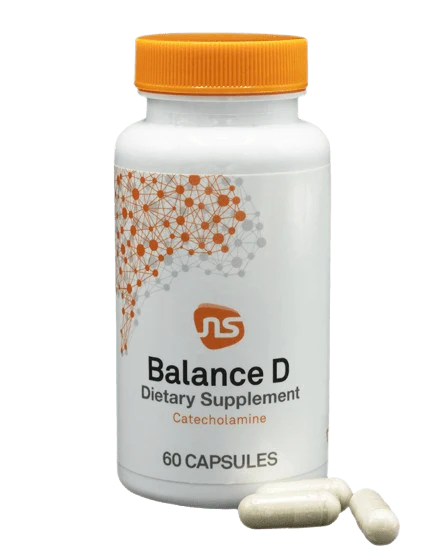

Balance D - 60 Capsules
NeuroScience Balance D
Contains ingredients important for the synthesis of dopamine, a catecholamine important for maintaining positive affect, optimal mood, cognition, and balancing cravings
The Science:
Catecholamines
A class of neurotransmitters responsible for many functions in the nervous and endocrine systems
- Catecholamines play an important role in mood, energy, memory, attention, and cognition
For more information, check out our blog posts - NeuroScience For Winning at Brain Health and NeuroScience - It’ll Blow Your Mind!
Ingredients
|
Serving Size: 2 Capsules |
Amount/Serving |
| Vitamin C (as ascorbic acid) | 200 mg |
| Vitamin B6 (as pyridoxal 5'-phosphate) | 0.5 mg |
| Folate (as L-5-methyltetrahydrofolate, calcium salt) | 240 mcg DFE |
| Selenium (as L-selenomethionine) | 70 mcg |
|
Proprietary Blend: |
1.15 g |
| N-acetyl-L-cysteine, N-acetyl-L-tyrosine, and Mucuna cochinchinensis extract (seed) (99% L-DOPA) |
Other Ingredients: Vegetable capsule (hypromellose, water), microcrystalline cellulose, magnesium stearate (vegetable source), silica, and dicalcium phosphate.
Suggested Use
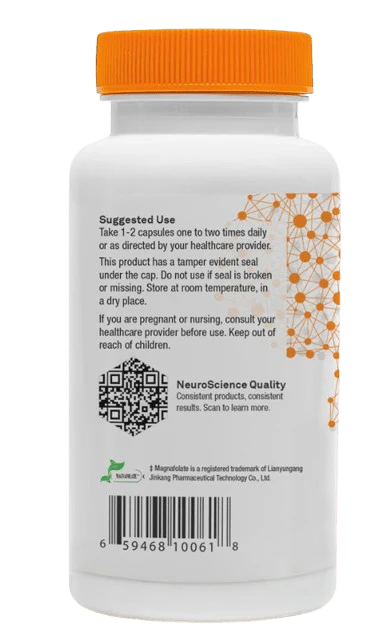
Take 1-2 capsules one to two times daily or as directed by your healthcare provider. Do not exceed the suggested use.
Warning: If you are pregnant or nursing, consult your healthcare provider before use. Keep out of reach of children.
Storage: This product has a tamper-evident seal under the cap. Do not use if the seal is broken or missing. Store at room temperature, in a dry place.
More Info.
Dopamine is important for craving control
Dopaminergic function is critical in the regulation of cravings, reward based behaviors, and weight management
- Dopamine release from the ventral tegmental area (VTA) to the nucleus accumbans is the primary pathway in which reward based behaviors such as cravings are modulated
- Impaired signaling from decreased dopamine release or receptors (DRD2) is thought to reduce sensitivity to natural reward-based behavior in vitro
Balance D provides ingredients to support dopamine synthesis
- N-acetyl-L-tyrosine and Mucuna cochinchinensis seed extract (99% L-DOPA) are amino acid precursors to dopamine
- Vitamin B6 is a necessary cofactor for the synthesis of dopamine
Formulated for a comprehensive pathway approach
Produced in excess, dopamine is oxidized into quinones, free radicals, and reactive oxygen species (ROS)
- Quinones react with glutathione (GSH) and deplete levels of the reduced GSH and total antioxidant capacity
- Excessive production of ROS and decreased antioxidant function contributes to cellular damage, dysfunction, and/or death
Balance D contains ingredients for the synthesis of glutathione
- N-acetyl-L-cysteine is the precursor to L-cysteine; L-cysteine is an amino acid precursor in the synthesis of glutathione
- Selenium is a micronutrient that helps to comprise selenoproteins; these proteins are crucial for brain function and the enzyme glutathione peroxidase (GPx)
Original: $40.50
-70%$40.50
$12.15Product Information
Product Information
Shipping & Returns
Shipping & Returns
Description
NeuroScience Balance D
Contains ingredients important for the synthesis of dopamine, a catecholamine important for maintaining positive affect, optimal mood, cognition, and balancing cravings
The Science:
Catecholamines
A class of neurotransmitters responsible for many functions in the nervous and endocrine systems
- Catecholamines play an important role in mood, energy, memory, attention, and cognition
For more information, check out our blog posts - NeuroScience For Winning at Brain Health and NeuroScience - It’ll Blow Your Mind!
Ingredients
|
Serving Size: 2 Capsules |
Amount/Serving |
| Vitamin C (as ascorbic acid) | 200 mg |
| Vitamin B6 (as pyridoxal 5'-phosphate) | 0.5 mg |
| Folate (as L-5-methyltetrahydrofolate, calcium salt) | 240 mcg DFE |
| Selenium (as L-selenomethionine) | 70 mcg |
|
Proprietary Blend: |
1.15 g |
| N-acetyl-L-cysteine, N-acetyl-L-tyrosine, and Mucuna cochinchinensis extract (seed) (99% L-DOPA) |
Other Ingredients: Vegetable capsule (hypromellose, water), microcrystalline cellulose, magnesium stearate (vegetable source), silica, and dicalcium phosphate.
Suggested Use
Take 1-2 capsules one to two times daily or as directed by your healthcare provider. Do not exceed the suggested use.
Warning: If you are pregnant or nursing, consult your healthcare provider before use. Keep out of reach of children.
Storage: This product has a tamper-evident seal under the cap. Do not use if the seal is broken or missing. Store at room temperature, in a dry place.
More Info.
Dopamine is important for craving control
Dopaminergic function is critical in the regulation of cravings, reward based behaviors, and weight management
- Dopamine release from the ventral tegmental area (VTA) to the nucleus accumbans is the primary pathway in which reward based behaviors such as cravings are modulated
- Impaired signaling from decreased dopamine release or receptors (DRD2) is thought to reduce sensitivity to natural reward-based behavior in vitro
Balance D provides ingredients to support dopamine synthesis
- N-acetyl-L-tyrosine and Mucuna cochinchinensis seed extract (99% L-DOPA) are amino acid precursors to dopamine
- Vitamin B6 is a necessary cofactor for the synthesis of dopamine
Formulated for a comprehensive pathway approach
Produced in excess, dopamine is oxidized into quinones, free radicals, and reactive oxygen species (ROS)
- Quinones react with glutathione (GSH) and deplete levels of the reduced GSH and total antioxidant capacity
- Excessive production of ROS and decreased antioxidant function contributes to cellular damage, dysfunction, and/or death
Balance D contains ingredients for the synthesis of glutathione
- N-acetyl-L-cysteine is the precursor to L-cysteine; L-cysteine is an amino acid precursor in the synthesis of glutathione
- Selenium is a micronutrient that helps to comprise selenoproteins; these proteins are crucial for brain function and the enzyme glutathione peroxidase (GPx)