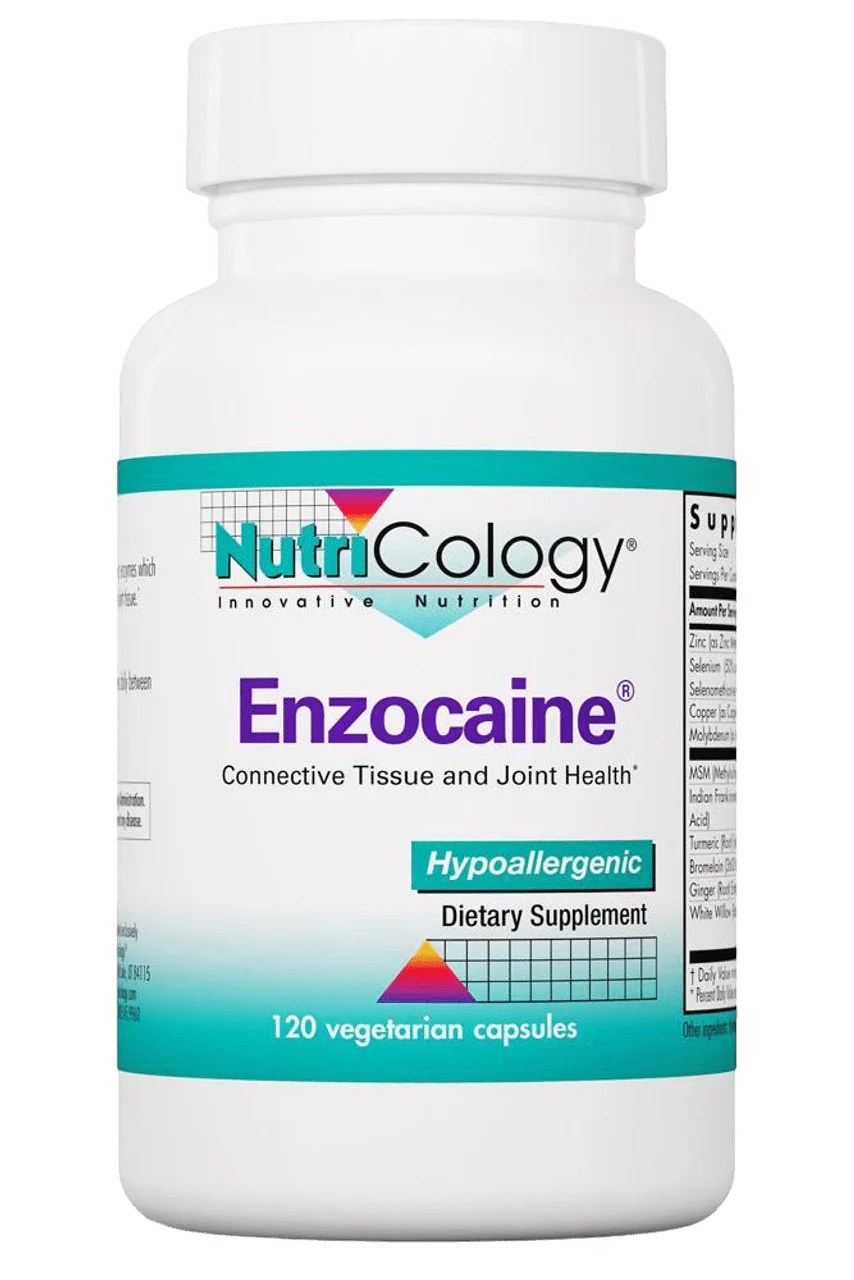


Enzocaine® Connective Tissue and Joint Health
NutriCology Enzocaine®
Connective Tissue and Joint Health
Enzocaine® combines a synergistic blend of herbs, nutrients, and proteolytic enzymes which provide nutritional support for connective tissue and joint tissue. These nutrients have been shown to support the body’s regulation within normal levels of some intermediary metabolites, such as cyclooxygenase (COX I & II) enzymes, arachidonic acid, lipoxygenase and leukotrienes.
Key Features:
- Provides nutritional support for connective tissue and joint health
- Supports regulation within normal levels of cyclooxygenase enzymes and other intermediary metabolites
- Provides antioxidant activity to protect from free radical damage
Ingredients
| Serving Size: 2 Vegetarian Capsules | Amount/Serving |
| Zinc (as Zinc Methionate) | 10 mg |
| Selenium (50% as Sodium Selenite and 50% as Selenomethionine) | 40 mcg |
| Copper (as Copper Bisglycinate) | 1 mg |
| Molybdenum (as Sodium Molybdate) | 300 mcg |
| MSM (Methylsulfonylmethane) | 500 mg |
| Turmeric (Root) Extract (95% Curcumin) | 400 mg |
| Bromelain (3600 MCU/g) | 400 mg |
| BOSWELLIN®(Boswellia serrata resin) (Standardized to 70% Boswellic Acids) | 200 mg |
| Ginger (Root) Extract (5% Gingerol) | 40 mg |
| White Willow (Bark) Extract (standardized to 15% Salicin) | 50 mg |
Other Ingredients: Hydroxypropyl methylcellulose, L-leucine.
Suggested Use
As a dietary supplement, 2 capsules one or two times daily between meals, or as directed by a healthcare practitioner.
Storage: Keep in a cool, dry place, tightly capped.
More Info
MSM (methylsulfonylmethane), a major metabolite of DMSO (dimethyl sulfoxide), is a source of biological sulfur, which is a major component in many of the body’s proteins, tissues, hormones and enzymes. Sulfur is an essential element of many glycosaminoglycans (GAGs) and is required for the healthy function and structure of joint cartilage. MSM is a natural constituent of a variety of foods, and is well absorbed and distributed throughout the body. In addition to its support of GAG synthesis and potential support of healthy connective tissue, MSM may enhance the cellular mucosal membranes.
Indian frankincense (Boswellia serrata) is a large, deciduous tree that grows in the dry, hilly countryside of India. The resinous exudate, an oleogum resin called Salai guggul, has been used for thousands of years in the Ayurvedic (Indian) tradition to support joint and connective tissue health. Recent clinical trials with boswellia gum demonstrated it has potential to support gastrointestinal health as well. The active components, boswellic acids, inhibit 5-lipoxygenase’s biosynthesis of leukotrienes.
Turmeric from the root of the southern Asian shrub Curcuma longa is used extensively for color and flavor in curry cuisine. Ayurvedic herbology also includes turmeric in many formulas. Turmeric’s key constituent, curcumin, inhibits thromboxanes and leukotrienes, as well as cyclooxygenase-2 and nitric oxide synthase. Curcumin also has antioxidant activity.
Bromelain, a pineapple proteolytic enzyme, is thought to modulate the arachidonate cascade, helping to promote a healthy prostaglandin balance. Ginger (Zingiber officinale) is used in both Ayurvedic and traditional Chinese herbology. Ginger’s oleoresin constituents exhibit potent inhibition of the synthesis of prostaglandins and leukotrienes. The components shogaol and paradol inhibit cyclooxygenase-2 enzyme activity dose-dependently, while gingerol inhibits 5-lipoxygenase.
White willow bark (Salix alba), a traditional analgesic and antipyretic, contains salicylates, including salicin, and salicylic acid. Salicylates inhibit cyclooxygenase activity. White willow bark is generally well tolerated by the human gastrointestinal system.
Product Information
Product Information
Shipping & Returns
Shipping & Returns
Description
NutriCology Enzocaine®
Connective Tissue and Joint Health
Enzocaine® combines a synergistic blend of herbs, nutrients, and proteolytic enzymes which provide nutritional support for connective tissue and joint tissue. These nutrients have been shown to support the body’s regulation within normal levels of some intermediary metabolites, such as cyclooxygenase (COX I & II) enzymes, arachidonic acid, lipoxygenase and leukotrienes.
Key Features:
- Provides nutritional support for connective tissue and joint health
- Supports regulation within normal levels of cyclooxygenase enzymes and other intermediary metabolites
- Provides antioxidant activity to protect from free radical damage
Ingredients
| Serving Size: 2 Vegetarian Capsules | Amount/Serving |
| Zinc (as Zinc Methionate) | 10 mg |
| Selenium (50% as Sodium Selenite and 50% as Selenomethionine) | 40 mcg |
| Copper (as Copper Bisglycinate) | 1 mg |
| Molybdenum (as Sodium Molybdate) | 300 mcg |
| MSM (Methylsulfonylmethane) | 500 mg |
| Turmeric (Root) Extract (95% Curcumin) | 400 mg |
| Bromelain (3600 MCU/g) | 400 mg |
| BOSWELLIN®(Boswellia serrata resin) (Standardized to 70% Boswellic Acids) | 200 mg |
| Ginger (Root) Extract (5% Gingerol) | 40 mg |
| White Willow (Bark) Extract (standardized to 15% Salicin) | 50 mg |
Other Ingredients: Hydroxypropyl methylcellulose, L-leucine.
Suggested Use
As a dietary supplement, 2 capsules one or two times daily between meals, or as directed by a healthcare practitioner.
Storage: Keep in a cool, dry place, tightly capped.
More Info
MSM (methylsulfonylmethane), a major metabolite of DMSO (dimethyl sulfoxide), is a source of biological sulfur, which is a major component in many of the body’s proteins, tissues, hormones and enzymes. Sulfur is an essential element of many glycosaminoglycans (GAGs) and is required for the healthy function and structure of joint cartilage. MSM is a natural constituent of a variety of foods, and is well absorbed and distributed throughout the body. In addition to its support of GAG synthesis and potential support of healthy connective tissue, MSM may enhance the cellular mucosal membranes.
Indian frankincense (Boswellia serrata) is a large, deciduous tree that grows in the dry, hilly countryside of India. The resinous exudate, an oleogum resin called Salai guggul, has been used for thousands of years in the Ayurvedic (Indian) tradition to support joint and connective tissue health. Recent clinical trials with boswellia gum demonstrated it has potential to support gastrointestinal health as well. The active components, boswellic acids, inhibit 5-lipoxygenase’s biosynthesis of leukotrienes.
Turmeric from the root of the southern Asian shrub Curcuma longa is used extensively for color and flavor in curry cuisine. Ayurvedic herbology also includes turmeric in many formulas. Turmeric’s key constituent, curcumin, inhibits thromboxanes and leukotrienes, as well as cyclooxygenase-2 and nitric oxide synthase. Curcumin also has antioxidant activity.
Bromelain, a pineapple proteolytic enzyme, is thought to modulate the arachidonate cascade, helping to promote a healthy prostaglandin balance. Ginger (Zingiber officinale) is used in both Ayurvedic and traditional Chinese herbology. Ginger’s oleoresin constituents exhibit potent inhibition of the synthesis of prostaglandins and leukotrienes. The components shogaol and paradol inhibit cyclooxygenase-2 enzyme activity dose-dependently, while gingerol inhibits 5-lipoxygenase.
White willow bark (Salix alba), a traditional analgesic and antipyretic, contains salicylates, including salicin, and salicylic acid. Salicylates inhibit cyclooxygenase activity. White willow bark is generally well tolerated by the human gastrointestinal system.