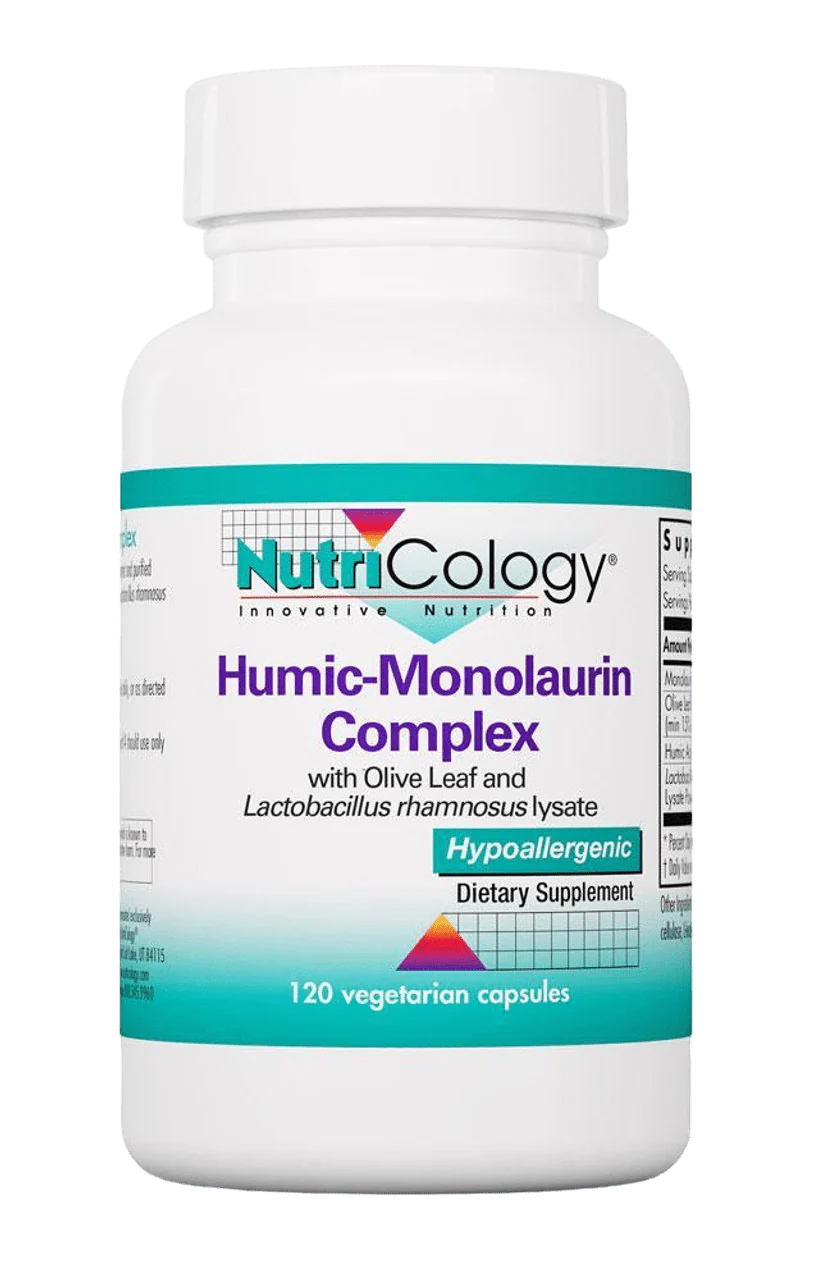

Humic-Monolaurin Complex
NutriCology Humic-Monolaurin Complex
with Olive Leaf and Lactobacillus rhamnosus lysate
Humic acids are the organic components of soil, peats, brown coals, shales, and lake sediments, formed from decomposed plant material. They are complex, long-chain molecules, varying in molecular weight from 5,000 to 50,000 daltons. Humic substances are the most abundant source of non-living organic material found in nature.
The humic acid utilized in Humic-Monolaurin Complex undergoes a specialized proprietary extraction and purification process, and has an average size of about 50,000 Daltons. These large molecules are very flexible and have enhanced conformation and attachment capacities. This humic acid can bind to cell surfaces with no adverse effects on the cell itself or on cell growth, and can stimulate normal, healthy resistance and immune response.
Monolaurin is made from lauric acid, a saturated fatty acid that comprises approximately 50% of the fatty acid content of coconut oil. Lauric acid makes up 6% of the fatty acid content found in human breast milk, and 3% of that found in cow’s milk and goat’s milk. Monolaurin may help boost the immune system. Humic-Monolaurin Complex also contains a standardized extract of olive tree leaves (Olea europa), with a minimum of 15% oleuropein, the bitter principle of olives, and a lysate powder made from cell wall fragments of Lactobacillus rhamnosus. These lactobacillus cell wall fragments have shown significant immune system-supporting properties.
Key Features:
- Provides antioxidant activity and supports a normal, healthy immune response
- Helps neutralize and remove toxins
- Supports a general sense of well-being
Ingredients
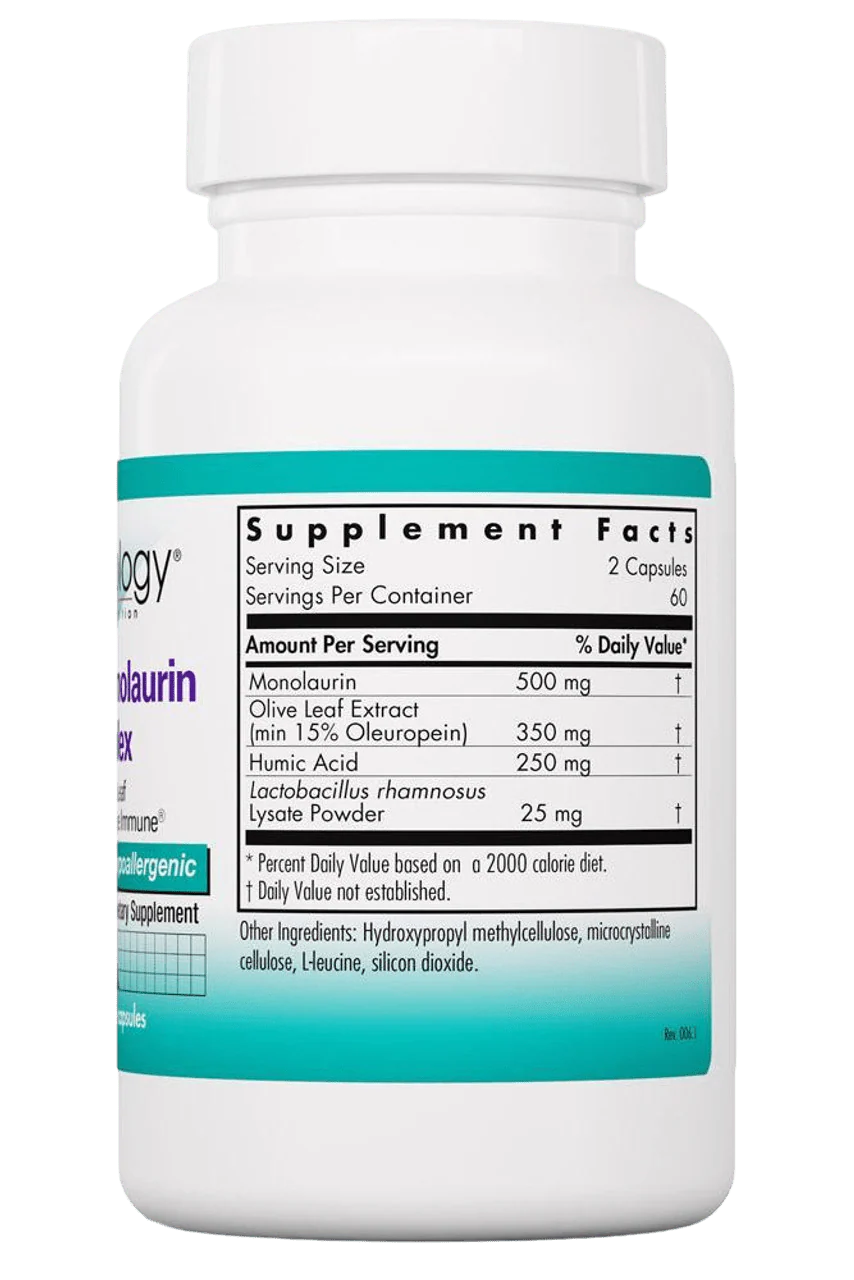
| Serving Size: 2 Vegetarian Capsules | Amount/Serving |
| Monolaurin | 500 mg |
| Olive Leaf Extract (min 15% Oleuropein) | 350 mg |
| Humic Acid | 250 mg |
| Lactobacillus rhamnosus Lysate Powder | 25 mg |
Other Ingredients: Hydroxypropyl methylcellulose, microcrystalline cellulose, L-leucine, silicon dioxide.
Suggested Use
As a dietary supplement, 2 capsules two or three times daily, or as directed by a healthcare practitioner. Pregnant or nursing women, or children under the age of 4 should use only under the guidance of a healthcare practitioner.
Storage: Keep in a cool, dry place, tightly capped.
More Info
As a group, humic acids present a kaleidoscope of soluble carbon. Humic substances are formed under many different environmental conditions and from a variety of starting materials, and humates from different regions of the earth contain various amounts and types of organic groups and configurations. Humic Acid Humic acid characteristics are also determined by how the deposit formed during the process of humification. The quality of product material for health or agricultural use is also affected by how the humic acid is extracted and purified.
In the soil, humic acids increase the permeability of plant membranes and enhance uptake of minerals and other nutrients, provide pH buffering, and help degrade and transport hydrophobic organic chemicals. They improve soil fertility, support the growth of helpful probiotic microbes, and enhance the sprouting of seeds and the growth and development of plants. They also impart the dark brown or black color to surface soils. Biologically active humic substances provide a biochemical bridge between minerals and living plant matter.
Humic acid contains a wide range of essential minerals, and it can increase cell wall permeability, facilitating transport of minerals to the cells. Humic acid has antioxidant activity, helps neutralize and remove toxins, and supports a general sense of well-being.
Product Information
Product Information
Shipping & Returns
Shipping & Returns
Description
NutriCology Humic-Monolaurin Complex
with Olive Leaf and Lactobacillus rhamnosus lysate
Humic acids are the organic components of soil, peats, brown coals, shales, and lake sediments, formed from decomposed plant material. They are complex, long-chain molecules, varying in molecular weight from 5,000 to 50,000 daltons. Humic substances are the most abundant source of non-living organic material found in nature.
The humic acid utilized in Humic-Monolaurin Complex undergoes a specialized proprietary extraction and purification process, and has an average size of about 50,000 Daltons. These large molecules are very flexible and have enhanced conformation and attachment capacities. This humic acid can bind to cell surfaces with no adverse effects on the cell itself or on cell growth, and can stimulate normal, healthy resistance and immune response.
Monolaurin is made from lauric acid, a saturated fatty acid that comprises approximately 50% of the fatty acid content of coconut oil. Lauric acid makes up 6% of the fatty acid content found in human breast milk, and 3% of that found in cow’s milk and goat’s milk. Monolaurin may help boost the immune system. Humic-Monolaurin Complex also contains a standardized extract of olive tree leaves (Olea europa), with a minimum of 15% oleuropein, the bitter principle of olives, and a lysate powder made from cell wall fragments of Lactobacillus rhamnosus. These lactobacillus cell wall fragments have shown significant immune system-supporting properties.
Key Features:
- Provides antioxidant activity and supports a normal, healthy immune response
- Helps neutralize and remove toxins
- Supports a general sense of well-being
Ingredients
| Serving Size: 2 Vegetarian Capsules | Amount/Serving |
| Monolaurin | 500 mg |
| Olive Leaf Extract (min 15% Oleuropein) | 350 mg |
| Humic Acid | 250 mg |
| Lactobacillus rhamnosus Lysate Powder | 25 mg |
Other Ingredients: Hydroxypropyl methylcellulose, microcrystalline cellulose, L-leucine, silicon dioxide.
Suggested Use
As a dietary supplement, 2 capsules two or three times daily, or as directed by a healthcare practitioner. Pregnant or nursing women, or children under the age of 4 should use only under the guidance of a healthcare practitioner.
Storage: Keep in a cool, dry place, tightly capped.
More Info
As a group, humic acids present a kaleidoscope of soluble carbon. Humic substances are formed under many different environmental conditions and from a variety of starting materials, and humates from different regions of the earth contain various amounts and types of organic groups and configurations. Humic Acid Humic acid characteristics are also determined by how the deposit formed during the process of humification. The quality of product material for health or agricultural use is also affected by how the humic acid is extracted and purified.
In the soil, humic acids increase the permeability of plant membranes and enhance uptake of minerals and other nutrients, provide pH buffering, and help degrade and transport hydrophobic organic chemicals. They improve soil fertility, support the growth of helpful probiotic microbes, and enhance the sprouting of seeds and the growth and development of plants. They also impart the dark brown or black color to surface soils. Biologically active humic substances provide a biochemical bridge between minerals and living plant matter.
Humic acid contains a wide range of essential minerals, and it can increase cell wall permeability, facilitating transport of minerals to the cells. Humic acid has antioxidant activity, helps neutralize and remove toxins, and supports a general sense of well-being.