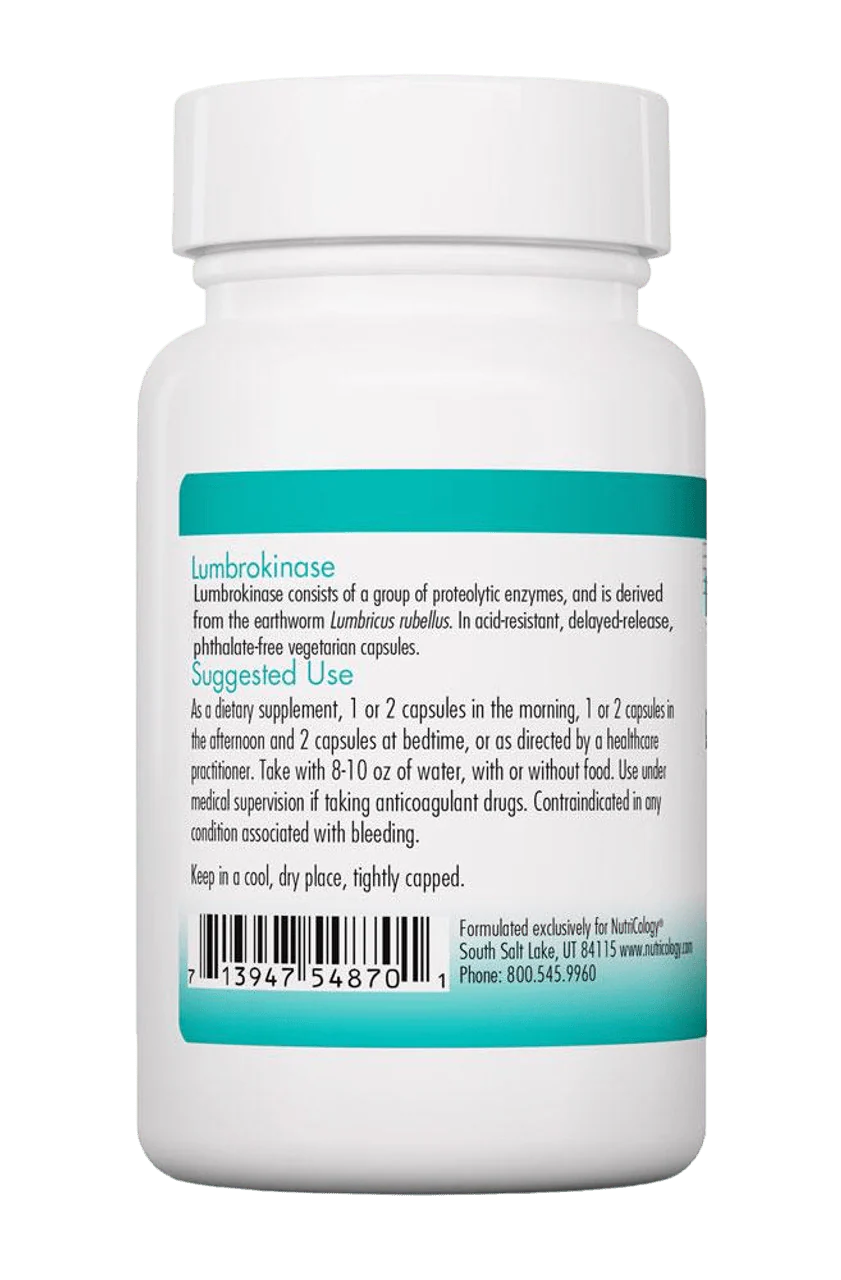

Lumbrokinase Delayed Release Vegicaps
NutriCology Lumbrokinase Delayed Release Vegicaps
Circulatory System Support
Since 1992, lumbrokinase derived from earthworms has been extensively studied and used in China. Research has shown lumbrokinase to support healthy coagulation of blood within normal levels and enhance fibrinolytic activity, i.e. similar to nattokinase. The lumbrokinase group of proteolytic enzymes, extracted from Lumbricus rubellus, includes plasminogen activator and plasmin. The plasminogen activator (e-PA) in lumbrokinase is similar to tissue plasminogen activator (t-PA) from other sources, which makes it possible to show the thrombolytic activity only in the presence of fibrin. Therefore, lumbrokinase has the advantage of not causing excessive bleeding.
Key Features:
- Supports healthy coagulation of blood within normal levels
- May enhance fibrinolytic activity, similar to nattokinase
- Supports healthy blood viscosity within normal levels
Ingredients
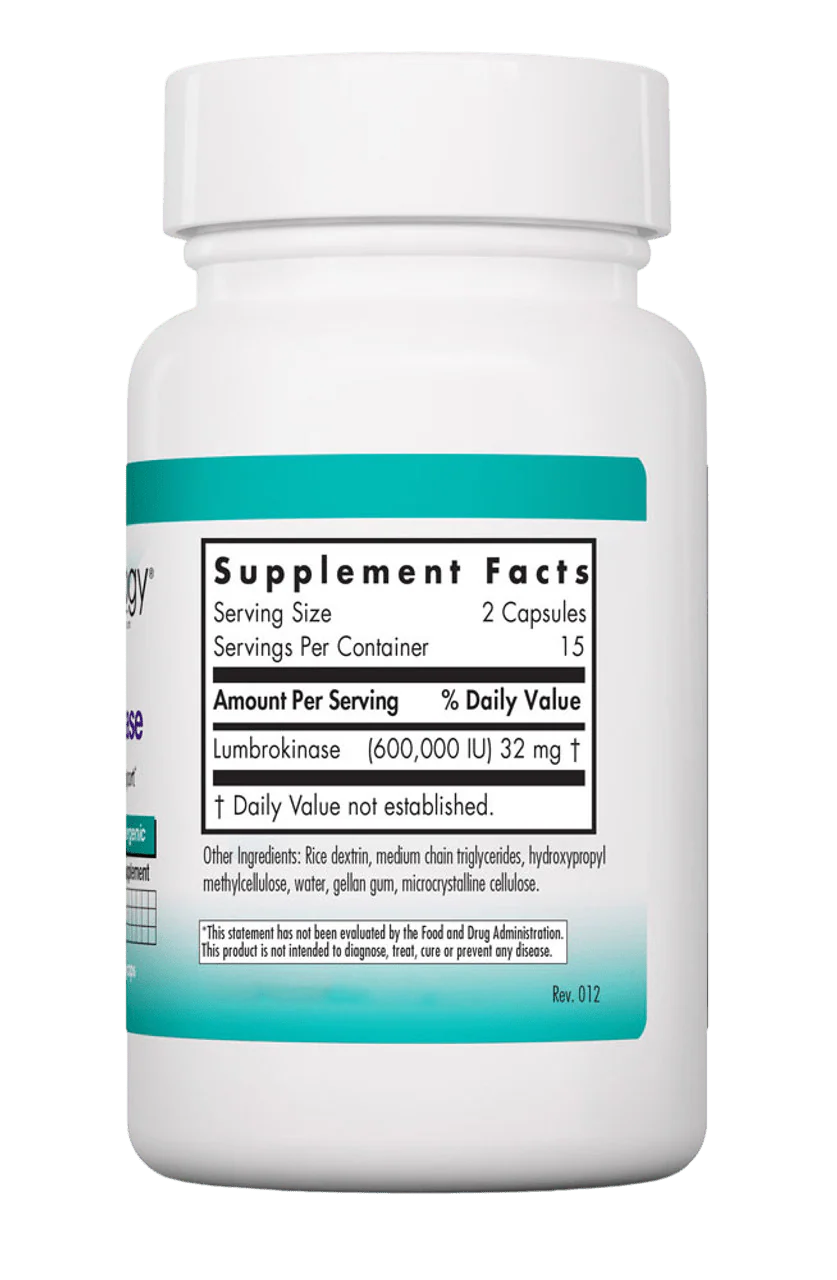
| Serving Size: 2 Vegetarian Capsules | Amount/Serving |
| Lumbrokinase (600,000 IU) | 32 mg |
Other Ingredients: Rice dextrin, medium chain triglycerides, hydroxypropyl methylcellulose, water, gellan gum, microcrystalline cellulose.
Suggested Use
As a dietary supplement, 1 or 2 capsules in the morning, 1 or 2 capsules in the afternoon, and 2 capsules at bedtime, or as directed by a healthcare practitioner. Take with 8-10 oz of water, with or without food.
Warning: Use under medical supervision if taking anticoagulant drugs. Contraindicated in any conditions associated with bleeding.
Storage: Keep in a cool, dry place, tightly capped.
More Info
Evidence of the human use of earthworms goes back many centuries. According to the ancient Chinese medical publication Ben Cao Gang Ma (Compendium of Materia Medica), earthworm (Lumbricus rubellus) was said to unblock the body’s meridians and channels, and was used to support blood circulation. In 1883, in a book discussing the action of worms, Charles Darwin observed that earthworm digestive fluids can dissolve fibrin. In the 1980s, Japanese researchers extracted a fibrin dissolving enzyme from Lumbricus rubellus, and found that it consisted of six proteolytic enzymes, collectively named lumbrokinase.
Lumbrokinase’s mechanisms of action include participation in the activation of plasminogen, and direct activity on fibrin itself. Lumbrokinase primarily proteolyzes fibrinogen and fibrin, hardly hydrolyzing other plasma proteins including plasminogen and albumin. The enzymes in Lumbrokinase have very strong fibrinolytic activity, are stable in a wide pH range, and show great stability against thermal inactivation and degradation. They are alkaline trypsin-like proteases that are greater than trypsins in their stability and tolerance to organic solvents. The activity of Lumbrokinase is much higher than most traditional Chinese products that are available in the United States. Significant amounts of Lumbrokinase have been shown to be transported through the intestinal epithelium, even in healthy subjects.
Original: $61.39
-70%$61.39
$18.42Product Information
Product Information
Shipping & Returns
Shipping & Returns
Description
NutriCology Lumbrokinase Delayed Release Vegicaps
Circulatory System Support
Since 1992, lumbrokinase derived from earthworms has been extensively studied and used in China. Research has shown lumbrokinase to support healthy coagulation of blood within normal levels and enhance fibrinolytic activity, i.e. similar to nattokinase. The lumbrokinase group of proteolytic enzymes, extracted from Lumbricus rubellus, includes plasminogen activator and plasmin. The plasminogen activator (e-PA) in lumbrokinase is similar to tissue plasminogen activator (t-PA) from other sources, which makes it possible to show the thrombolytic activity only in the presence of fibrin. Therefore, lumbrokinase has the advantage of not causing excessive bleeding.
Key Features:
- Supports healthy coagulation of blood within normal levels
- May enhance fibrinolytic activity, similar to nattokinase
- Supports healthy blood viscosity within normal levels
Ingredients
| Serving Size: 2 Vegetarian Capsules | Amount/Serving |
| Lumbrokinase (600,000 IU) | 32 mg |
Other Ingredients: Rice dextrin, medium chain triglycerides, hydroxypropyl methylcellulose, water, gellan gum, microcrystalline cellulose.
Suggested Use
As a dietary supplement, 1 or 2 capsules in the morning, 1 or 2 capsules in the afternoon, and 2 capsules at bedtime, or as directed by a healthcare practitioner. Take with 8-10 oz of water, with or without food.
Warning: Use under medical supervision if taking anticoagulant drugs. Contraindicated in any conditions associated with bleeding.
Storage: Keep in a cool, dry place, tightly capped.
More Info
Evidence of the human use of earthworms goes back many centuries. According to the ancient Chinese medical publication Ben Cao Gang Ma (Compendium of Materia Medica), earthworm (Lumbricus rubellus) was said to unblock the body’s meridians and channels, and was used to support blood circulation. In 1883, in a book discussing the action of worms, Charles Darwin observed that earthworm digestive fluids can dissolve fibrin. In the 1980s, Japanese researchers extracted a fibrin dissolving enzyme from Lumbricus rubellus, and found that it consisted of six proteolytic enzymes, collectively named lumbrokinase.
Lumbrokinase’s mechanisms of action include participation in the activation of plasminogen, and direct activity on fibrin itself. Lumbrokinase primarily proteolyzes fibrinogen and fibrin, hardly hydrolyzing other plasma proteins including plasminogen and albumin. The enzymes in Lumbrokinase have very strong fibrinolytic activity, are stable in a wide pH range, and show great stability against thermal inactivation and degradation. They are alkaline trypsin-like proteases that are greater than trypsins in their stability and tolerance to organic solvents. The activity of Lumbrokinase is much higher than most traditional Chinese products that are available in the United States. Significant amounts of Lumbrokinase have been shown to be transported through the intestinal epithelium, even in healthy subjects.