Milk Thistle Seed Complex
NutriCology Milk Thistle Seed Complex
with Phyllanthus and Dandelion
Milk Thistle Seed Complex provides significant amounts of three important herbs for supporting optimal liver function. The liver is the main metabolic processing organ in the body, and it performs the crucial task of disarming toxins ingested from air, water, food, drugs, or created from the body’s metabolism, so they can be safely eliminated. The liver also manufactures bile, which is then stored in the gall bladder. The detoxification process of the liver works in two phases. The first, called the mixed-function oxidase system, oxidizes toxins, often creating molecules more toxic than the original molecules. The second phase, called the conjugation phase, converts the toxic metabolites from phase I into harmless molecules, such as glucoronides, ester sulfates, and glutathione conjugates.
Key Features:
- Provides synergistic hepatoprotective effect of three powerful herbs in one formula
- Provides support for phase II liver detoxification and glutathione efficiency
- Supports liver, kidney, gall bladder, and digestive functions
Ingredients
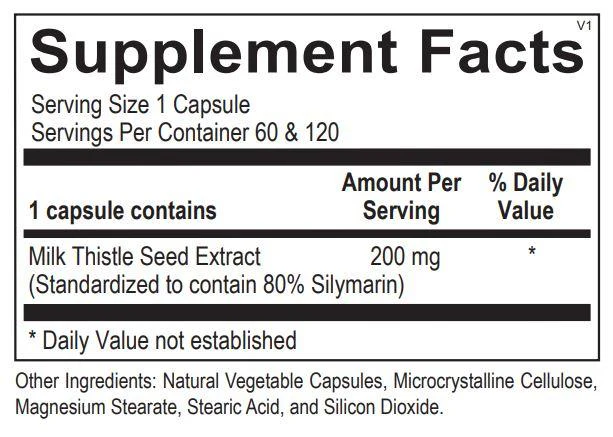
| Serving Size: 1 Vegetarian Capsule | Amount/Serving |
| Phyllanthus amarus (Leaves) Extract | 200 mg |
| Milk Thistle (Seed) Extract (standardized to 80% Silymarin |
200 mg |
| Dandelion (Root) Extract | 200 mg |
Other Ingredients: Hydroxypropyl methylcellulose, microcrystalline cellulose, L-leucine.
Suggested Use
As a dietary supplement, 1 capsule two or three times daily with meals, or as directed by a healthcare practitioner.
Storage: Variations in product color may occur. Keep in a cool, dry place, tightly capped.
More Info
Milk thistle grows all over the globe, including Europe, Asia, and the Americas. Although farmers sometimes consider it a noxious weed, it has a long history of use for liver support. Modern research confirms that milk thistle may offer significant protection for the liver. It has been shown to help protect the liver from damage from exposure to carbon tetrachloride and other pollutants, alcohol ingestion, or acetaminophen overdose. It stimulates the flow of bile and urine, aiding digestion and the excretion of toxins from the body. Silymarin, a mixture of various flavonolignans, is the major active component of milk thistle and is typically standardized for best results. Silymarin protects hepatocytes through an action on their membranes, stimulates hepatic protein synthesis, inhibits lipoxygenase, functions as an antioxidant, and supports phase II liver detoxification by preventing glutathione depletion.
The Phyllanthus genus encompasses more than 600 species, found throughout the tropics and subtropics from Asia to the Americas. The species Phyllanthus amarus, P. niruri and P. urinaria are closely-related in appearance, phytochemical structure and history of use. (Some experts now classify P. amarus as a type of P. niruri.) They have been utilized by traditional healers all over the world, and their common names include chanca piedra, quebra pedra (“stone breaker” or “shatter stone”), bahupatra, and bhoomi amalaki. Phyllanthus has long been used in Ayurvedic medicine and by native healers in South America, primarily to support the biliary and urinary systems, including the gall bladder, kidney and liver. Researchers in China, India and Great Britain confirm that phyllanthus has significant hepatoprotective properties.
Dandelion is found all over the world, and has traditionally been used both for food and to support health. Traditionally it has been used to support liver, gall bladder and digestive function, and to promote healthy skin. It enhances bile production in the liver and its release from the gall bladder, and can have a mild diuretic and laxative action.
Product Information
Product Information
Shipping & Returns
Shipping & Returns
Description
NutriCology Milk Thistle Seed Complex
with Phyllanthus and Dandelion
Milk Thistle Seed Complex provides significant amounts of three important herbs for supporting optimal liver function. The liver is the main metabolic processing organ in the body, and it performs the crucial task of disarming toxins ingested from air, water, food, drugs, or created from the body’s metabolism, so they can be safely eliminated. The liver also manufactures bile, which is then stored in the gall bladder. The detoxification process of the liver works in two phases. The first, called the mixed-function oxidase system, oxidizes toxins, often creating molecules more toxic than the original molecules. The second phase, called the conjugation phase, converts the toxic metabolites from phase I into harmless molecules, such as glucoronides, ester sulfates, and glutathione conjugates.
Key Features:
- Provides synergistic hepatoprotective effect of three powerful herbs in one formula
- Provides support for phase II liver detoxification and glutathione efficiency
- Supports liver, kidney, gall bladder, and digestive functions
Ingredients
| Serving Size: 1 Vegetarian Capsule | Amount/Serving |
| Phyllanthus amarus (Leaves) Extract | 200 mg |
| Milk Thistle (Seed) Extract (standardized to 80% Silymarin |
200 mg |
| Dandelion (Root) Extract | 200 mg |
Other Ingredients: Hydroxypropyl methylcellulose, microcrystalline cellulose, L-leucine.
Suggested Use
As a dietary supplement, 1 capsule two or three times daily with meals, or as directed by a healthcare practitioner.
Storage: Variations in product color may occur. Keep in a cool, dry place, tightly capped.
More Info
Milk thistle grows all over the globe, including Europe, Asia, and the Americas. Although farmers sometimes consider it a noxious weed, it has a long history of use for liver support. Modern research confirms that milk thistle may offer significant protection for the liver. It has been shown to help protect the liver from damage from exposure to carbon tetrachloride and other pollutants, alcohol ingestion, or acetaminophen overdose. It stimulates the flow of bile and urine, aiding digestion and the excretion of toxins from the body. Silymarin, a mixture of various flavonolignans, is the major active component of milk thistle and is typically standardized for best results. Silymarin protects hepatocytes through an action on their membranes, stimulates hepatic protein synthesis, inhibits lipoxygenase, functions as an antioxidant, and supports phase II liver detoxification by preventing glutathione depletion.
The Phyllanthus genus encompasses more than 600 species, found throughout the tropics and subtropics from Asia to the Americas. The species Phyllanthus amarus, P. niruri and P. urinaria are closely-related in appearance, phytochemical structure and history of use. (Some experts now classify P. amarus as a type of P. niruri.) They have been utilized by traditional healers all over the world, and their common names include chanca piedra, quebra pedra (“stone breaker” or “shatter stone”), bahupatra, and bhoomi amalaki. Phyllanthus has long been used in Ayurvedic medicine and by native healers in South America, primarily to support the biliary and urinary systems, including the gall bladder, kidney and liver. Researchers in China, India and Great Britain confirm that phyllanthus has significant hepatoprotective properties.
Dandelion is found all over the world, and has traditionally been used both for food and to support health. Traditionally it has been used to support liver, gall bladder and digestive function, and to promote healthy skin. It enhances bile production in the liver and its release from the gall bladder, and can have a mild diuretic and laxative action.