Omega 3 BasiX™
Xymogen Omega 3 BasiX™
Enhanced Absorption-Ready Omega-3s
Omega 3 BasiX™ is an IFOS-certified fish oil formula that delivers absorption-ready omega-3s. This sustainably sourced, pure, and fresh fish oil is enhanced with patented MaxSimil® lipid absorption technology, resulting in highly absorbable monoglyceride EPA and DHA that contribute to the levels needed for optimal health.
Key Benefits:
- Provides EPA and DHA
- Premium Monoglyceride Omega-3 Fatty Acids
- 3× More Absorbed Than Ethyl Ester Fish Oil
- 2× More Absorbed Than Triglyceride Fish Oil
Ingredients
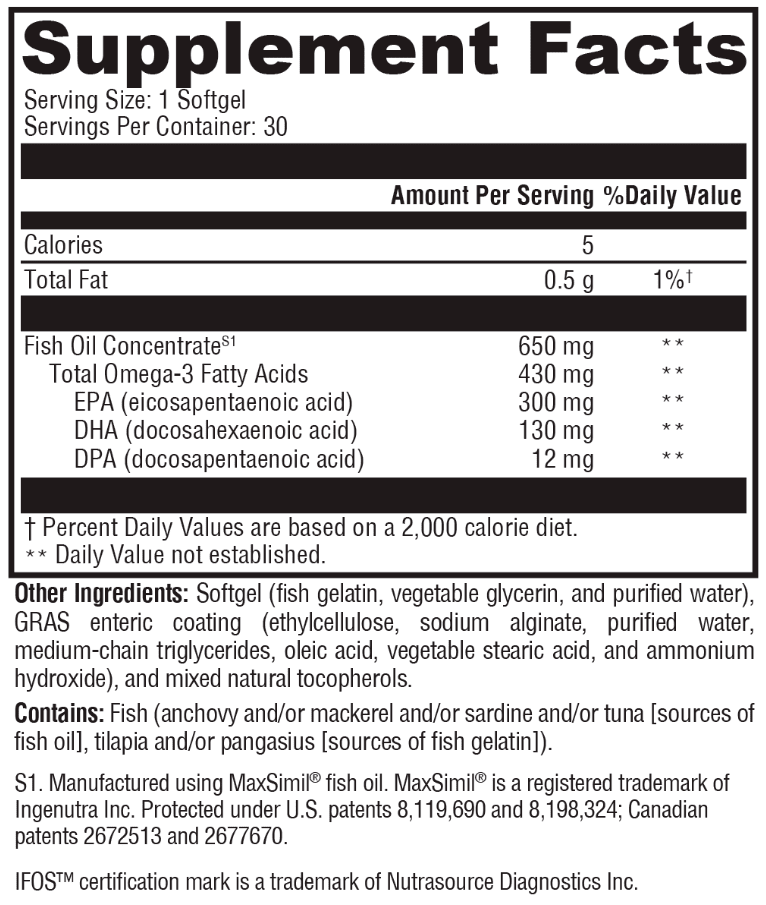
| Serving Size: 1 Softgel | Amount/Serving |
| Calories | 5 |
| Total Fat | 0.5 g |
| Fish Oil Concentrate | 650 mg |
| Total Omega-3 Fatty Acids | 430 mg |
| EPA (eicosapentaenoic acid) | 300 mg |
| DHA (docosahexaenoic acid) | 130 mg |
| DPA (docosapentaenoic acid) | 12 mg |
Other Ingredients: Softgel (fish gelatin, vegetable glycerin, and purified water), GRAS enteric coating (ethylcellulose, sodium alginate, purified water, medium-chain triglycerides, oleic acid, vegetable stearic acid, and ammonium hydroxide), and mixed natural tocopherols.
Contains: Fish (anchovy and/or mackerel and/or sardine and/or tuna [sources of fish oil], tilapia and/or pangasius [sources of fish gelatin]).
Does Not Contain: Wheat, gluten, corn, yeast, soy protein, dairy products, shellfish, peanuts, tree nuts, egg, sesame, ingredients derived from genetically modified organisms (GMOs), artificial colors, and artificial sweeteners.
Suggested Use
Take one softgel daily, or use as directed by your healthcare professional
Warning: Consult your healthcare professional before use. Individuals taking blood thinners or other medications should discuss potential interactions with their healthcare professional. Do not use if the tamper seal is damaged.
Storage: Keep closed in a cool, dry place out of reach of children.
More Info.
Regular consumption of fish as part of an overall healthy eating pattern has been linked to a wide range of health benefits, largely because of its omega-3 fatty acid content. Most research on omega-3s has focused on eicosapentaenoic acid (EPA), docosahexaenoic acid (DHA), and alpha-linolenic acid (ALA). Dietary sources of EPA and DHA are predominantly cold-water fatty fish species, such as salmon, tuna, mackerel, herring, sardines, and anchovies, whereas ALA comes primarily from plant-based foods like flaxseed, walnuts, chia, soybeans, canola, and their oils. Although the body can convert ALA to EPA and DHA, reported conversion rates vary and are typically less than 15%. Therefore, direct intake of foods that contain EPA and DHA and/or concentrated supplemental sources is often recommended to support optimal omega-3 status and associated positive health outcomes.
Heart Health
A wide evidence base supports a link between intake of fish/fish oil and heart health. Both the American Heart Association and the Dietary Guidelines for Americans recommend eating patterns that include fish to support heart health. In addition, the Food and Drug Administration (FDA) allows products that contain at least 0.8 g of combined EPA and DHA per serving to use a qualified health claim linking omega-3 consumption to a reduced risk of coronary heart disease.
Brain Health
From early brain development to support for the aging brain, omega-3s have been
documented for their role in supporting brain health throughout the lifespan. As a structural component of brain cell membranes, omega-3s play a vital role in cognitive processes ranging from learning and memory to focus and mood regulation.
Cytokine Balance
Cytokine balance refers to the equilibrium between signaling molecules that regulate immune responses. This is fundamental to human health because it is the body’s natural response to injury, stress, and harmful microorganisms. Decades of scientific literature have linked the intake of omega-3s with balanced cytokine activity.
Variations in the Bioavailability of Supplemental Fish Oils
Omega-3 fatty acid supplements can vary broadly in absorbability and quality, which is highly dependent on the type of fish oil. The most common supplemental forms of omega-3 fatty acids include triglyceride (TG), ethyl ester (EE), and free fatty acids (FFAs). Triglyceride is the molecular form of omega-3 that naturally occurs in fish; this form is made up of 3 fatty acids attached to a glycerol backbone. The EE form is created through the chemical synthesis of the TG form, replacing the glycerol molecule with ethanol to allow for the selective concentration of EPA and DHA beyond what naturally occurs in fish. To achieve higher amounts of EPA and DHA in the TG form, it can be converted to the EE form and then re-esterified back to the TG form. Free fatty acids are not bound to a
backbone molecule like glycerol or ethanol; hence, they are referred to as FFA or free form.
Overall, omega-3s, as either natural or re-esterified TG or as FFAs, have somewhat higher bioavailability than EE. Studies have indicated that the absorption of the free form is better than that of both TG and EE, which is attributed to the latter forms requiring emulsification with bile salts, followed by enzymatic digestion to yield FFAs and monoglycerides for absorption into mucosal cells. However, because of its high susceptibility to oxidation, which limits shelf life, the FFA form is rarely used in commercial products. In contrast, the TG and EE forms have better stability, with the TG form being more resistant to oxidation than the EE form.
MaxSimil®
MaxSimil® patented lipid absorption technology is a novel monoglyceride delivery system that enhances the absorption of omega-3s from fish oil by bypassing the emulsification and enzymatic digestion steps without the use of additional ingredients. These features make MaxSimil fish oils optimal for delivering shelf-stable omega-3 fatty acids, especially to individuals with compromised digestive health. Studies suggest that MaxSimil fish oils have 2 to 3 times greater absorption of EPA and DHA compared with TG and EE fish oils.
In a trial comparing the pharmacokinetics of monoacylglyceride (MAG) predigested fish oil with EE fish oil in humans, healthy adults (N = 20) were given a single oral dose of 3 g of MAG or EE fish oil that contained 1800 mg of EPA and 1200 mg of DHA. When comparing results from the MAG group with those given EE, subjects who consumed MAG had a maximum concentration (Cmax) of EPA and DHA up to 3 times greater. Also, at 24 hours after ingestion, the residual concentration of EPA was maintained at twice the initial level. Additionally, males and females in the MAG group had similar Cmax absorption for EPA and DHA, whereas in the EE group, the men absorbed significantly less than the women.
In another trial, the pharmacokinetics of MAG, EE, and TG forms of omega-3 were
evaluated and compared for absorption and potential side effects. Healthy adult subjects (N = 22) consumed a single dose of each form, containing ~880 mg of EPA and ~332 mg of DHA, with low-fat meals provided during a 24-hour monitoring period. Results showed that MAG produced a 3-fold higher Cmax absorption of EPA and DHA compared with EE and a 2-fold increase compared with TG. Additionally, the 24-hour concentration for EPA and DHA was up to 2 times higher with MAG than EE or TG, indicating superior absorption. The authors concluded that MAG could achieve comparable plasma omega-3 levels at lower doses than EE and TG. Additionally, no significant differences in reported side effects were observed between the different forms.
The studies discussed above, including data from their published supplemental materials, suggest that the MAG form of fish oil is 3 times more absorbed than EE and 2 times more absorbed than TG. Although further research is needed to confirm the results, these studies contribute evidence that omega-3s from MaxSimil MAGs are more bioavailable than those from the EE or TG forms of fish oil.
Omega 3 BasiX is a proprietary MaxSimil composition containing monoglyceride fish oil encapsulated in an enteric-coated fish-gelatin softgel. Each batch is IFOS-certified to the International Fish Oil Standards for purity, potency, safety, and freshness. One serving provides 650 mg of highly absorbable, concentrated fish oil, contributing EPA and DHA to help support optimal omega-3 levels.
Product Information
Product Information
Shipping & Returns
Shipping & Returns
Description
Xymogen Omega 3 BasiX™
Enhanced Absorption-Ready Omega-3s
Omega 3 BasiX™ is an IFOS-certified fish oil formula that delivers absorption-ready omega-3s. This sustainably sourced, pure, and fresh fish oil is enhanced with patented MaxSimil® lipid absorption technology, resulting in highly absorbable monoglyceride EPA and DHA that contribute to the levels needed for optimal health.
Key Benefits:
- Provides EPA and DHA
- Premium Monoglyceride Omega-3 Fatty Acids
- 3× More Absorbed Than Ethyl Ester Fish Oil
- 2× More Absorbed Than Triglyceride Fish Oil
Ingredients
| Serving Size: 1 Softgel | Amount/Serving |
| Calories | 5 |
| Total Fat | 0.5 g |
| Fish Oil Concentrate | 650 mg |
| Total Omega-3 Fatty Acids | 430 mg |
| EPA (eicosapentaenoic acid) | 300 mg |
| DHA (docosahexaenoic acid) | 130 mg |
| DPA (docosapentaenoic acid) | 12 mg |
Other Ingredients: Softgel (fish gelatin, vegetable glycerin, and purified water), GRAS enteric coating (ethylcellulose, sodium alginate, purified water, medium-chain triglycerides, oleic acid, vegetable stearic acid, and ammonium hydroxide), and mixed natural tocopherols.
Contains: Fish (anchovy and/or mackerel and/or sardine and/or tuna [sources of fish oil], tilapia and/or pangasius [sources of fish gelatin]).
Does Not Contain: Wheat, gluten, corn, yeast, soy protein, dairy products, shellfish, peanuts, tree nuts, egg, sesame, ingredients derived from genetically modified organisms (GMOs), artificial colors, and artificial sweeteners.
Suggested Use
Take one softgel daily, or use as directed by your healthcare professional
Warning: Consult your healthcare professional before use. Individuals taking blood thinners or other medications should discuss potential interactions with their healthcare professional. Do not use if the tamper seal is damaged.
Storage: Keep closed in a cool, dry place out of reach of children.
More Info.
Regular consumption of fish as part of an overall healthy eating pattern has been linked to a wide range of health benefits, largely because of its omega-3 fatty acid content. Most research on omega-3s has focused on eicosapentaenoic acid (EPA), docosahexaenoic acid (DHA), and alpha-linolenic acid (ALA). Dietary sources of EPA and DHA are predominantly cold-water fatty fish species, such as salmon, tuna, mackerel, herring, sardines, and anchovies, whereas ALA comes primarily from plant-based foods like flaxseed, walnuts, chia, soybeans, canola, and their oils. Although the body can convert ALA to EPA and DHA, reported conversion rates vary and are typically less than 15%. Therefore, direct intake of foods that contain EPA and DHA and/or concentrated supplemental sources is often recommended to support optimal omega-3 status and associated positive health outcomes.
Heart Health
A wide evidence base supports a link between intake of fish/fish oil and heart health. Both the American Heart Association and the Dietary Guidelines for Americans recommend eating patterns that include fish to support heart health. In addition, the Food and Drug Administration (FDA) allows products that contain at least 0.8 g of combined EPA and DHA per serving to use a qualified health claim linking omega-3 consumption to a reduced risk of coronary heart disease.
Brain Health
From early brain development to support for the aging brain, omega-3s have been
documented for their role in supporting brain health throughout the lifespan. As a structural component of brain cell membranes, omega-3s play a vital role in cognitive processes ranging from learning and memory to focus and mood regulation.
Cytokine Balance
Cytokine balance refers to the equilibrium between signaling molecules that regulate immune responses. This is fundamental to human health because it is the body’s natural response to injury, stress, and harmful microorganisms. Decades of scientific literature have linked the intake of omega-3s with balanced cytokine activity.
Variations in the Bioavailability of Supplemental Fish Oils
Omega-3 fatty acid supplements can vary broadly in absorbability and quality, which is highly dependent on the type of fish oil. The most common supplemental forms of omega-3 fatty acids include triglyceride (TG), ethyl ester (EE), and free fatty acids (FFAs). Triglyceride is the molecular form of omega-3 that naturally occurs in fish; this form is made up of 3 fatty acids attached to a glycerol backbone. The EE form is created through the chemical synthesis of the TG form, replacing the glycerol molecule with ethanol to allow for the selective concentration of EPA and DHA beyond what naturally occurs in fish. To achieve higher amounts of EPA and DHA in the TG form, it can be converted to the EE form and then re-esterified back to the TG form. Free fatty acids are not bound to a
backbone molecule like glycerol or ethanol; hence, they are referred to as FFA or free form.
Overall, omega-3s, as either natural or re-esterified TG or as FFAs, have somewhat higher bioavailability than EE. Studies have indicated that the absorption of the free form is better than that of both TG and EE, which is attributed to the latter forms requiring emulsification with bile salts, followed by enzymatic digestion to yield FFAs and monoglycerides for absorption into mucosal cells. However, because of its high susceptibility to oxidation, which limits shelf life, the FFA form is rarely used in commercial products. In contrast, the TG and EE forms have better stability, with the TG form being more resistant to oxidation than the EE form.
MaxSimil®
MaxSimil® patented lipid absorption technology is a novel monoglyceride delivery system that enhances the absorption of omega-3s from fish oil by bypassing the emulsification and enzymatic digestion steps without the use of additional ingredients. These features make MaxSimil fish oils optimal for delivering shelf-stable omega-3 fatty acids, especially to individuals with compromised digestive health. Studies suggest that MaxSimil fish oils have 2 to 3 times greater absorption of EPA and DHA compared with TG and EE fish oils.
In a trial comparing the pharmacokinetics of monoacylglyceride (MAG) predigested fish oil with EE fish oil in humans, healthy adults (N = 20) were given a single oral dose of 3 g of MAG or EE fish oil that contained 1800 mg of EPA and 1200 mg of DHA. When comparing results from the MAG group with those given EE, subjects who consumed MAG had a maximum concentration (Cmax) of EPA and DHA up to 3 times greater. Also, at 24 hours after ingestion, the residual concentration of EPA was maintained at twice the initial level. Additionally, males and females in the MAG group had similar Cmax absorption for EPA and DHA, whereas in the EE group, the men absorbed significantly less than the women.
In another trial, the pharmacokinetics of MAG, EE, and TG forms of omega-3 were
evaluated and compared for absorption and potential side effects. Healthy adult subjects (N = 22) consumed a single dose of each form, containing ~880 mg of EPA and ~332 mg of DHA, with low-fat meals provided during a 24-hour monitoring period. Results showed that MAG produced a 3-fold higher Cmax absorption of EPA and DHA compared with EE and a 2-fold increase compared with TG. Additionally, the 24-hour concentration for EPA and DHA was up to 2 times higher with MAG than EE or TG, indicating superior absorption. The authors concluded that MAG could achieve comparable plasma omega-3 levels at lower doses than EE and TG. Additionally, no significant differences in reported side effects were observed between the different forms.
The studies discussed above, including data from their published supplemental materials, suggest that the MAG form of fish oil is 3 times more absorbed than EE and 2 times more absorbed than TG. Although further research is needed to confirm the results, these studies contribute evidence that omega-3s from MaxSimil MAGs are more bioavailable than those from the EE or TG forms of fish oil.
Omega 3 BasiX is a proprietary MaxSimil composition containing monoglyceride fish oil encapsulated in an enteric-coated fish-gelatin softgel. Each batch is IFOS-certified to the International Fish Oil Standards for purity, potency, safety, and freshness. One serving provides 650 mg of highly absorbable, concentrated fish oil, contributing EPA and DHA to help support optimal omega-3 levels.