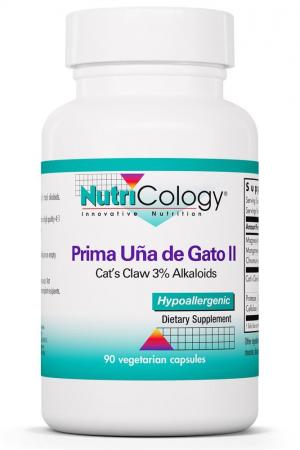
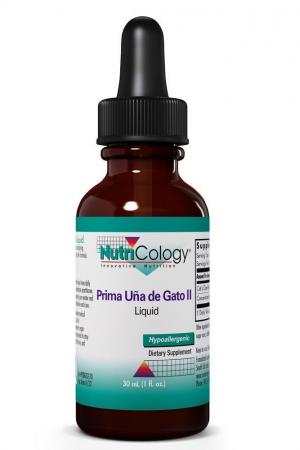
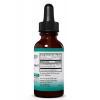
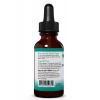
Prima Una de Gato II
NutriCology Prima Una de Gato II has been discontinued by the manufacturer.
Cat's claw (Uncaria tomentosa) extract containing 3% total alkaloids. Minerals and enzymes are added to the formula.
Ingredients
Capsules:
| Serving Size: 1 capsule | Amount Per Serving |
| Magnesium (as magnesium malate) | 19 mg |
| Manganese (as manganese citrate) | 30 mcg |
| Chromium (as chromium polynicotinate) | 5 mg |
| Cat's Claw extract 4:1 (3% total alkaloids) | 93.75 mg |
| Protease (30,000 HUT) | 60 mg |
| Cellulase (1,600 CU) | 20 mg |
Other Ingredients: Microcrystalline cellulose, magnesium stearate, silicon dioxide, hydroxypropyl methylcellulose
Liquid:
| Serving Size: 5 drops | Amount/Serving |
| Cat’s Claw Bark Extract 1:4 |
50 mg |
| Concentrated Minerals | 10% |
| Ethanol content: 34-36% from organic sugar cane, distilled water |
Suggested Use
Capsules: As a dietary supplement, 1 capsule one to three times daily on an empty stomach, or as directed by a healthcare practitioner.
Liquid: As a dietary supplement, 1 to 5 drops one to three times daily on an empty stomach, or as directed by a healthcare practitioner. Put 1 to 5 drops in a glass, then add 4 ounces of pure water and wait one minute before drinking. Shake well before each use.
Warnings: Use under medical supervision. Herxheimer reaction may occur. Not recommended for pregnant or nursing women or organ transplant recipients. Keep in a cool, dry place, tightly capped.
More Info
Cat’s claw (Uncaria tomentosa) is a woody vine that has long been used by indigenous healers in the rainforests of the Peruvian Andes and elsewhere in South America and Central America. Its use dates back to the 1500s and the ancient Incan Empire. Asháninka priests in Peru reputedly considered cat’s claw to have great powers and life-giving properties. In recent times cat’s claw has been studied for its ability to support gastrointestinal and immune functions. Research suggests that in the gastrointestinal tract it can support healthy microbial balance and soothe irritated tissue. Cat’s claw has antioxidant properties, and it may support circulation by strengthening capillaries. Active constituents include pteropodine, isopteropodine, rhynchophylline, mitraphylline, hirsute, and quinovic acid glycosides
Product Information
Product Information
Shipping & Returns
Shipping & Returns
Description
NutriCology Prima Una de Gato II has been discontinued by the manufacturer.
Cat's claw (Uncaria tomentosa) extract containing 3% total alkaloids. Minerals and enzymes are added to the formula.
Ingredients
Capsules:
| Serving Size: 1 capsule | Amount Per Serving |
| Magnesium (as magnesium malate) | 19 mg |
| Manganese (as manganese citrate) | 30 mcg |
| Chromium (as chromium polynicotinate) | 5 mg |
| Cat's Claw extract 4:1 (3% total alkaloids) | 93.75 mg |
| Protease (30,000 HUT) | 60 mg |
| Cellulase (1,600 CU) | 20 mg |
Other Ingredients: Microcrystalline cellulose, magnesium stearate, silicon dioxide, hydroxypropyl methylcellulose
Liquid:
| Serving Size: 5 drops | Amount/Serving |
| Cat’s Claw Bark Extract 1:4 |
50 mg |
| Concentrated Minerals | 10% |
| Ethanol content: 34-36% from organic sugar cane, distilled water |
Suggested Use
Capsules: As a dietary supplement, 1 capsule one to three times daily on an empty stomach, or as directed by a healthcare practitioner.
Liquid: As a dietary supplement, 1 to 5 drops one to three times daily on an empty stomach, or as directed by a healthcare practitioner. Put 1 to 5 drops in a glass, then add 4 ounces of pure water and wait one minute before drinking. Shake well before each use.
Warnings: Use under medical supervision. Herxheimer reaction may occur. Not recommended for pregnant or nursing women or organ transplant recipients. Keep in a cool, dry place, tightly capped.
More Info
Cat’s claw (Uncaria tomentosa) is a woody vine that has long been used by indigenous healers in the rainforests of the Peruvian Andes and elsewhere in South America and Central America. Its use dates back to the 1500s and the ancient Incan Empire. Asháninka priests in Peru reputedly considered cat’s claw to have great powers and life-giving properties. In recent times cat’s claw has been studied for its ability to support gastrointestinal and immune functions. Research suggests that in the gastrointestinal tract it can support healthy microbial balance and soothe irritated tissue. Cat’s claw has antioxidant properties, and it may support circulation by strengthening capillaries. Active constituents include pteropodine, isopteropodine, rhynchophylline, mitraphylline, hirsute, and quinovic acid glycosides