
Quercetin 20× Plus
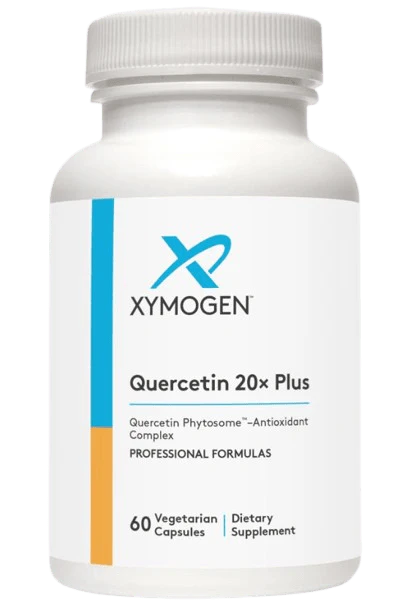
Xymogen Quercetin 20× Plus
Quercetin Phytosome™−Antioxidant Complex
- Provides Respiratory Support
- Promotes Nasal Comfort
- Provides Antioxidant Support
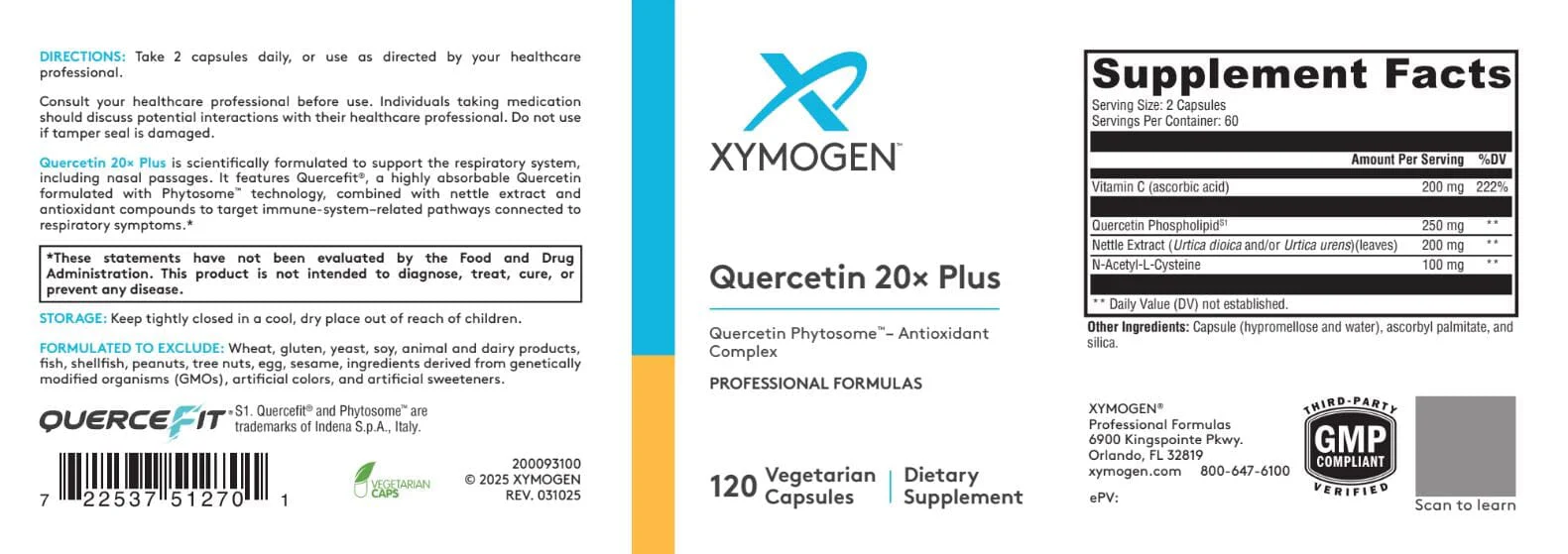
Quercetin 20× Plus is scientifically formulated to support the respiratory system, including nasal passages. It features Quercefit®, a highly absorbable Quercetin formulated with Phytosome™ technology, combined with nettle extract and antioxidant compounds to target immune-system−related pathways connected to respiratory symptoms.
Ingredients
| Serving Size: 2 Capsules | Amount/Serving |
| Vitamin C (ascorbic acid) | 200 mg |
| Quercetin Phospholipid | 250 mg |
| Nettle Extract (Urtica dioica and/or Urtica urens)(leaves) | 200 mg |
| N-Acetyl-L-Cysteine | 100 mg |
Other Ingredients: Capsule (hypromellose and water), ascorbyl palmitate, and silica.
Does Not Contain: Wheat, gluten, yeast, soy, animal and dairy products, fish, shellfish, peanuts, tree nuts, egg, sesame, ingredients derived from genetically modified organisms (GMOs), artificial colors, and artificial sweeteners.
Suggested Use
Take two capsules daily, or use as directed by your healthcare professional.
Warning: Consult your healthcare professional before use. Individuals taking medication should discuss potential interactions with their healthcare professional. Do not use if the tamper seal is damaged. Keep out of reach of children.
Storage: Keep tightly closed in a cool, dry place out of reach of children.
More Info.
Respiratory system challenges may be seasonal in some individuals or year-round in others. In many cases, individuals experience multiple symptoms. Such constellations may have various causes, including antigen or microorganism exposure, histamine activity, or immune reactivity. Regardless, the underlying immune responses have some commonalities, such as the mobilization of immune cells and inflammatory cytokines and the subsequent increase in oxidative stress, contributing to symptomatology. Quercetin 20× Plus provides a complex of active ingredients that may help the body balance immune-related responses, oxidative stress levels, and the associated respiratory symptoms.
Quercetin Phytosome® (Quercefit®)
Quercetin belongs to the flavonoid class of polyphenols and is found naturally in various medicinal plants as well as foods and drinks, including onions, apples, berries, brassica vegetables, nuts, wine, and black tea. The body of scientific evidence demonstrates that ingesting quercetin confers a wide range of benefits to human health, which are primarily mediated through quercetin’s antioxidant activities and immunomodulatory effects. For example, research results have shown quercetin has inhibitory effects on histamine release, eosinophil recruitment, and proinflammatory cytokine activity.4,5 Quercetin, like many other flavonoids, has relatively poor absorption in the gastrointestinal tract, causing limited bioavailability.
Quercetin Phytosome is considered a superior form of quercetin because of its increased bioavailability compared with standard quercetin. Phytosome technology complexes botanicals like quercetin with phospholipids, improving solubility and enhancing absorption. This improved bioavailability allows for better uptake by the body, which is important for efficacy. Riva et al6 conducted a single-dose, randomized, 6-sequence/3-period crossover clinical trial with a balanced carryover effect to evaluate the absorption of Quercetin Phytosome over unformulated quercetin in healthy volunteers under fasting conditions. One dose of quercetin (500 mg) and 2 different doses of Quercetin Phytosome (250 mg and 500 mg) were orally administered to subjects (N = 12), and pharmacokinetic samples were collected at 12 time points. The Cmax for 500 mg of Quercetin Phytosome was approximately 20-fold higher, and the AUC was approximately 18-fold larger than that of quercetin. The 250-mg dose of Quercetin Phytosome showed a pharmacokinetic profile similar to 500 mg but with Cmax and AUC values half the 500-mg dose, indicating a dose-dependent relationship. Other human studies show the respiratory-immune benefits of Quercetin Phytosome as follows.
A randomized, placebo-controlled, double-blind, parallel-group study (N = 66) explored the impact of Quercetin Phytosome in Japanese adults with eye and nose discomfort. Researchers conducted evaluations using Japanese Rhinoconjunctivitis Quality of Life Questionnaire scores and other tests. Over the course of 4 weeks, those consuming 200 mg/d of Quercetin Phytosome experienced significant subjective improvements in sleep and severity of symptoms, such as sneezing, ocular itching, and runny nose, compared with the placebo group.
Human studies also demonstrate the benefits of Quercetin Phytosome in individuals with early-stage respiratory illness. In addition to standard care, subjects taking doses of 500 to 1500 mg/d of Quercetin Phytosome demonstrated better clearance, improved resolution of acute symptoms, reduced illness progression, and reduced serum inflammatory biomarker levels compared with those receiving standard care alone.
N-Acetyl-L-Cysteine (NAC)
Oxidative stress and the interrelated production of inflammatory cytokines are thought to play a significant role in propagating respiratory symptoms in immune-reactive pathways. NAC has direct antioxidant activities and is a precursor to glutathione biosynthesis. Low glutathione levels are associated with oxidative stress and implicated in immune dysregulation—particularly T-cell–mediated functions. Replenishing antioxidants may be critical in normalizing immune function. NAC is also a mucolytic agent that decreases mucus viscosity and facilitates its clearance by hydrolyzing the disulfide bonds of mucus proteins.12 In an animal model of environmental hypersensitivity, NAC reduced lung oxidative stress, improved lung glutathione status, reduced inflammatory transcription factor (eg, NF-κB, TNF-α) activity, and decreased airway hyperresponsiveness.
Original: $29.99
-70%$29.99
$9.00Product Information
Product Information
Shipping & Returns
Shipping & Returns
Description
Xymogen Quercetin 20× Plus
Quercetin Phytosome™−Antioxidant Complex
- Provides Respiratory Support
- Promotes Nasal Comfort
- Provides Antioxidant Support
Quercetin 20× Plus is scientifically formulated to support the respiratory system, including nasal passages. It features Quercefit®, a highly absorbable Quercetin formulated with Phytosome™ technology, combined with nettle extract and antioxidant compounds to target immune-system−related pathways connected to respiratory symptoms.
Ingredients
| Serving Size: 2 Capsules | Amount/Serving |
| Vitamin C (ascorbic acid) | 200 mg |
| Quercetin Phospholipid | 250 mg |
| Nettle Extract (Urtica dioica and/or Urtica urens)(leaves) | 200 mg |
| N-Acetyl-L-Cysteine | 100 mg |
Other Ingredients: Capsule (hypromellose and water), ascorbyl palmitate, and silica.
Does Not Contain: Wheat, gluten, yeast, soy, animal and dairy products, fish, shellfish, peanuts, tree nuts, egg, sesame, ingredients derived from genetically modified organisms (GMOs), artificial colors, and artificial sweeteners.
Suggested Use
Take two capsules daily, or use as directed by your healthcare professional.
Warning: Consult your healthcare professional before use. Individuals taking medication should discuss potential interactions with their healthcare professional. Do not use if the tamper seal is damaged. Keep out of reach of children.
Storage: Keep tightly closed in a cool, dry place out of reach of children.
More Info.
Respiratory system challenges may be seasonal in some individuals or year-round in others. In many cases, individuals experience multiple symptoms. Such constellations may have various causes, including antigen or microorganism exposure, histamine activity, or immune reactivity. Regardless, the underlying immune responses have some commonalities, such as the mobilization of immune cells and inflammatory cytokines and the subsequent increase in oxidative stress, contributing to symptomatology. Quercetin 20× Plus provides a complex of active ingredients that may help the body balance immune-related responses, oxidative stress levels, and the associated respiratory symptoms.
Quercetin Phytosome® (Quercefit®)
Quercetin belongs to the flavonoid class of polyphenols and is found naturally in various medicinal plants as well as foods and drinks, including onions, apples, berries, brassica vegetables, nuts, wine, and black tea. The body of scientific evidence demonstrates that ingesting quercetin confers a wide range of benefits to human health, which are primarily mediated through quercetin’s antioxidant activities and immunomodulatory effects. For example, research results have shown quercetin has inhibitory effects on histamine release, eosinophil recruitment, and proinflammatory cytokine activity.4,5 Quercetin, like many other flavonoids, has relatively poor absorption in the gastrointestinal tract, causing limited bioavailability.
Quercetin Phytosome is considered a superior form of quercetin because of its increased bioavailability compared with standard quercetin. Phytosome technology complexes botanicals like quercetin with phospholipids, improving solubility and enhancing absorption. This improved bioavailability allows for better uptake by the body, which is important for efficacy. Riva et al6 conducted a single-dose, randomized, 6-sequence/3-period crossover clinical trial with a balanced carryover effect to evaluate the absorption of Quercetin Phytosome over unformulated quercetin in healthy volunteers under fasting conditions. One dose of quercetin (500 mg) and 2 different doses of Quercetin Phytosome (250 mg and 500 mg) were orally administered to subjects (N = 12), and pharmacokinetic samples were collected at 12 time points. The Cmax for 500 mg of Quercetin Phytosome was approximately 20-fold higher, and the AUC was approximately 18-fold larger than that of quercetin. The 250-mg dose of Quercetin Phytosome showed a pharmacokinetic profile similar to 500 mg but with Cmax and AUC values half the 500-mg dose, indicating a dose-dependent relationship. Other human studies show the respiratory-immune benefits of Quercetin Phytosome as follows.
A randomized, placebo-controlled, double-blind, parallel-group study (N = 66) explored the impact of Quercetin Phytosome in Japanese adults with eye and nose discomfort. Researchers conducted evaluations using Japanese Rhinoconjunctivitis Quality of Life Questionnaire scores and other tests. Over the course of 4 weeks, those consuming 200 mg/d of Quercetin Phytosome experienced significant subjective improvements in sleep and severity of symptoms, such as sneezing, ocular itching, and runny nose, compared with the placebo group.
Human studies also demonstrate the benefits of Quercetin Phytosome in individuals with early-stage respiratory illness. In addition to standard care, subjects taking doses of 500 to 1500 mg/d of Quercetin Phytosome demonstrated better clearance, improved resolution of acute symptoms, reduced illness progression, and reduced serum inflammatory biomarker levels compared with those receiving standard care alone.
N-Acetyl-L-Cysteine (NAC)
Oxidative stress and the interrelated production of inflammatory cytokines are thought to play a significant role in propagating respiratory symptoms in immune-reactive pathways. NAC has direct antioxidant activities and is a precursor to glutathione biosynthesis. Low glutathione levels are associated with oxidative stress and implicated in immune dysregulation—particularly T-cell–mediated functions. Replenishing antioxidants may be critical in normalizing immune function. NAC is also a mucolytic agent that decreases mucus viscosity and facilitates its clearance by hydrolyzing the disulfide bonds of mucus proteins.12 In an animal model of environmental hypersensitivity, NAC reduced lung oxidative stress, improved lung glutathione status, reduced inflammatory transcription factor (eg, NF-κB, TNF-α) activity, and decreased airway hyperresponsiveness.