DEPA - 100 Softgels
Douglas Laboratories DEPA has been discontinued by the manufacturer.
DEPA contains a marine lipid concentrate that has been processed by molecular distillation. DEPA provides omega-3 fatty acids, including eicosapentaenoic acid (EPA, 18%) and docosahexaenoic acid (DHA, 12%), in their triglyceride form.
Ingredients
Each serving contains:
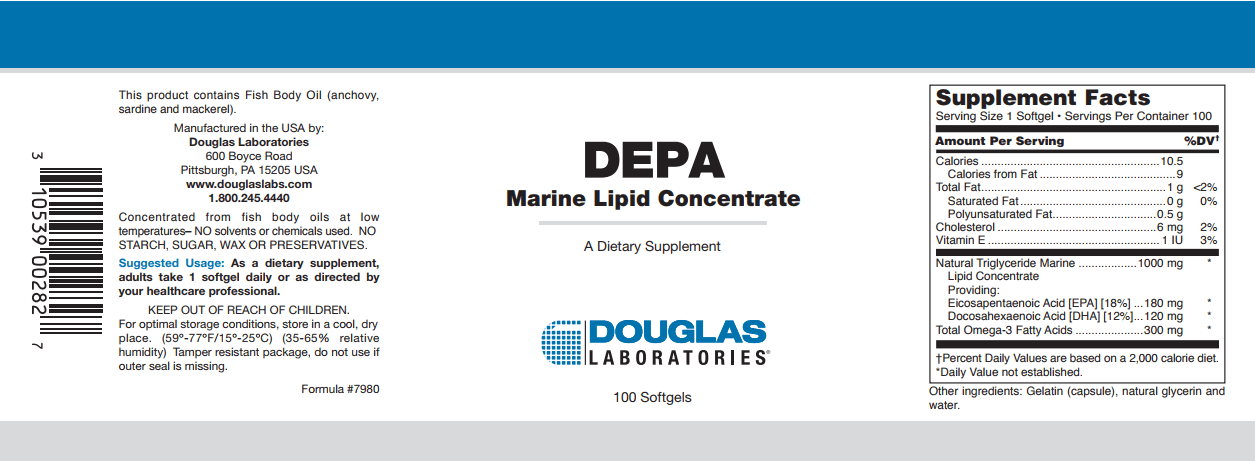
Calories - 10.5
Calories from Fat - 9 mg
Total Fat - 1 g
Saturated Fat - 0 g
Polyunsaturated Fat - 0.5 mg
Cholesterol - 6 mg
Vitamin E - 1 IU
Natural Triglyceride Marine - 1,000 mg
Lipid Concentrate
Providing:
Eicosapentaenoic Acid [EPA] [18%] - 180 mg
Docosahexaenoic Acid [DHA] [12%] - 120 mg
Total Omega-3 Fatty Acids - 300 mg
Other ingredients: Gelatin (capsule), natural glycerin and water.
Suggested Use
As a dietary supplement, adults take 1 softgel daily or as directed by your healthcare professional.
More Info.
Typical diets in developed countries deliver large amounts of saturated fatty acids and the polyunsaturated omega-6 linoleic and arachidonic acids and low levels of omega-3 fatty acids. Throughout evolution, humans were accustomed to diets providing roughly equal amounts of omega-6 and omega-3 fatty acids. However, during the last 200 years, the ratio of dietary omega-6:omega-3 fatty acids increased from about 1:1 to 20- 25:1. Leading health professionals now recommend ratios between 4:1 and 10:1.
A healthy balance of dietary omega-6 and omega-3 fatty acids appears to be a prerequisite for normal immune function. Dietary linoleic acid (18:2 omega-6) is a precursor to arachidonic acid (20:4) which in turn is a precursor for pro-inflammatory prostaglandin E2, leukotriene B4, and platelet aggregating thromboxane A2. The omega-3 fatty acids EPA and DHA provide a natural counterbalance, because they serve as precursors for the anti-inflammatory prostaglandins E1 and E3, and decrease the formation of prostaglandin E2 and thromboxane A2. Among other factors, sufficient dietary levels of EPA, DHA and other omega-3 fatty acids are also important in the regulation of normal blood lipoprotein and cholesterol levels.
Original: $24.80
-70%$24.80
$7.44Product Information
Product Information
Shipping & Returns
Shipping & Returns
Description
Douglas Laboratories DEPA has been discontinued by the manufacturer.
DEPA contains a marine lipid concentrate that has been processed by molecular distillation. DEPA provides omega-3 fatty acids, including eicosapentaenoic acid (EPA, 18%) and docosahexaenoic acid (DHA, 12%), in their triglyceride form.
Ingredients
Each serving contains:
Calories - 10.5
Calories from Fat - 9 mg
Total Fat - 1 g
Saturated Fat - 0 g
Polyunsaturated Fat - 0.5 mg
Cholesterol - 6 mg
Vitamin E - 1 IU
Natural Triglyceride Marine - 1,000 mg
Lipid Concentrate
Providing:
Eicosapentaenoic Acid [EPA] [18%] - 180 mg
Docosahexaenoic Acid [DHA] [12%] - 120 mg
Total Omega-3 Fatty Acids - 300 mg
Other ingredients: Gelatin (capsule), natural glycerin and water.
Suggested Use
As a dietary supplement, adults take 1 softgel daily or as directed by your healthcare professional.
More Info.
Typical diets in developed countries deliver large amounts of saturated fatty acids and the polyunsaturated omega-6 linoleic and arachidonic acids and low levels of omega-3 fatty acids. Throughout evolution, humans were accustomed to diets providing roughly equal amounts of omega-6 and omega-3 fatty acids. However, during the last 200 years, the ratio of dietary omega-6:omega-3 fatty acids increased from about 1:1 to 20- 25:1. Leading health professionals now recommend ratios between 4:1 and 10:1.
A healthy balance of dietary omega-6 and omega-3 fatty acids appears to be a prerequisite for normal immune function. Dietary linoleic acid (18:2 omega-6) is a precursor to arachidonic acid (20:4) which in turn is a precursor for pro-inflammatory prostaglandin E2, leukotriene B4, and platelet aggregating thromboxane A2. The omega-3 fatty acids EPA and DHA provide a natural counterbalance, because they serve as precursors for the anti-inflammatory prostaglandins E1 and E3, and decrease the formation of prostaglandin E2 and thromboxane A2. Among other factors, sufficient dietary levels of EPA, DHA and other omega-3 fatty acids are also important in the regulation of normal blood lipoprotein and cholesterol levels.